Tribal knowledge is your company's real source code.
The rules that actually run a business were never written down. They live in people, and they leave when people do.

Every company has two sets of rules. The first is written down: policies, process documents, the configuration of its software. The second is what people actually do. Most of the time the two agree. Where they don’t, the second set wins, because it’s the one that keeps the business running.
Look closely and you’ll find it everywhere. The planner who knows one machine runs slow after the weekend shutdown and schedules around it. The coordinator who phones a particular supplier instead of emailing, because emails to them go unanswered. The analyst who knows which public data source is unreliable in a particular region and always double-checks it. The clerk who knows the old system will reject an order if two fields disagree, and quietly fixes them before saving.
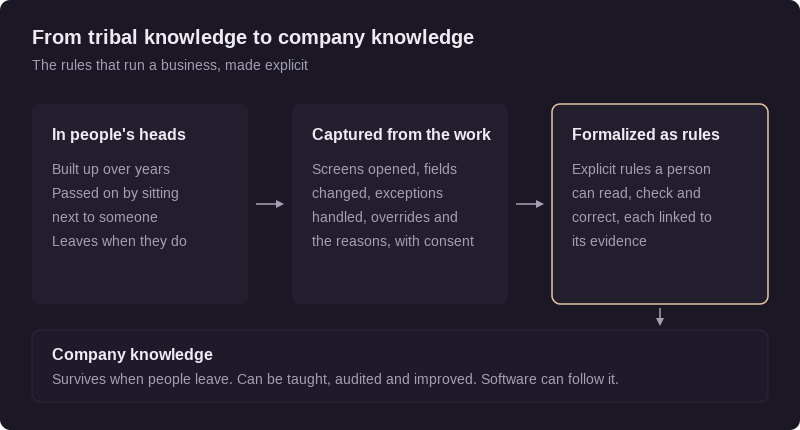
None of this is in a manual. It’s knowledge built up over years, passed on by sitting next to someone, and mostly invisible until it’s missing. It’s called tribal knowledge, and in most companies it’s the closest thing there is to the real source code of the business: the actual logic that turns inputs into outcomes.
It has three problems.
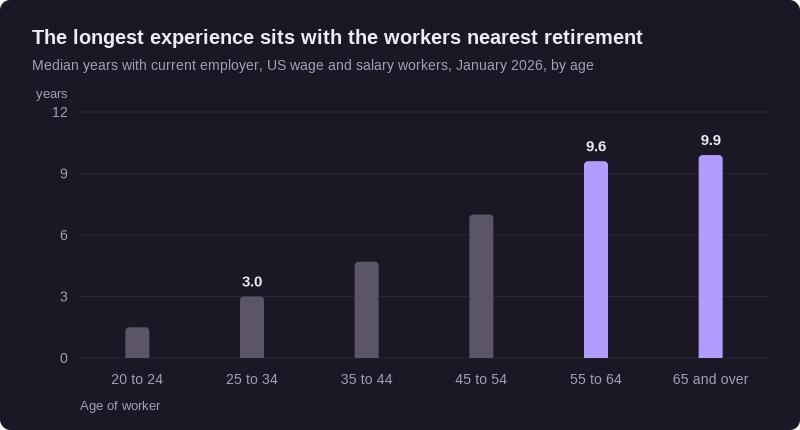
It leaves. When an experienced person retires or moves on, their knowledge goes with them. The replacement learns the job again, slowly, and makes the mistakes the predecessor had learned to avoid. Gartner warned in September 2026 that companies cutting staff for AI savings risk eroding institutional knowledge, and it expects nearly a third of employees laid off because of AI to be rehired by 2029, often at higher cost, The Register reported.
It doesn’t scale. One person’s judgment can only be in one place at a time. A team that depends on it is limited by that person’s hours.
It can’t be automated. Software, AI included, can only follow rules it has been given. If a rule exists only in someone’s head, no system can follow it. This is the quiet reason so many automation projects deliver less than promised: they automate the documented process and miss the undocumented one that really matters. As CNBC reported in July 2026, Ford is reportedly bringing back hundreds of experienced engineers to work on quality problems its automated systems could not solve; AI, one of its engineering vice presidents said, is only as good as the information used to train it.
The obvious fix is to ask people to write it down. It rarely works. Experts are busy. They don’t notice most of what they know, because it has become automatic. And documentation written once goes stale as soon as the work changes.
What works better is to capture knowledge where it shows itself: in the work. When people use their tools, their decisions leave traces: which screens they open, which fields they change, which exceptions they handle and how. When a manager overrides a plan, the override and the reason for it are knowledge. When an expert explains a decision in a conversation, the explanation can be recorded and tied to the case it was about. With consent, all of this can be collected without asking anyone to stop and write.
The next step is to formalize it: turn observed behavior into explicit rules that a person can read, check and correct, each one linked to the evidence it came from. At that point tribal knowledge becomes company knowledge. It survives when people leave. It can be taught, audited and improved. And, for the first time, software can follow it.
That’s the foundation everything else rests on. Automating a workflow, rebuilding an old application, handing work to an AI system: each is only as good as the knowledge underneath it.