Put the controls outside the model.
Models now read sensitive data and act on a company's behalf, and their reasoning is hard to trace. The oversight has to live somewhere the model can't reach.
When traditional software did something wrong, you could find out why. Somewhere there was a line of code, a configuration value or a bad input, and an engineer with enough patience could follow the path from cause to effect.
Models don’t work that way. Nobody can point to the part of a model that produced a particular answer, or say which training data made it take a particular action. And yet companies are giving models access to their most sensitive data and letting them change records, send messages and call other systems.
That gap is the problem Supervisor exists to close.
The responsibility doesn’t move
When a model acts on a company’s behalf, the company is still accountable for what happened. A provider’s terms of service don’t change that, and neither does a benchmark score. The customer whose order was cancelled by mistake doesn’t care which model did it.
So the question isn’t whether a model can be trusted in general. It’s whether you can see what it did, limit what it can do, and put things right when it gets something wrong.
We have done this before
We spent our careers in security: protecting email, and building open-source antivirus. That work is about running alongside code and messages you can’t fully trust, at scale, without stopping the business.
Security teams already know how to deal with a powerful actor inside a company. Give it an identity. Grant it only the access it needs. Log what it does. Draw boundaries it can’t cross. Assume that one day it will make a mistake or be compromised, and plan for that day.
Models deserve the same treatment. Not because they are malicious, but because anything capable enough to be useful is capable enough to do damage.
Why the controls can’t live in the model
The tempting answer is to ask the model to explain itself, or to have a second model check the first. Both help. Neither is enough. A model’s explanation of its reasoning isn’t guaranteed to match what actually drove its answer. A second model watching the first is one more layer you can’t see into.
Security settled this question decades ago. In 1972, James Anderson’s report for the US Air Force described the reference monitor: the mechanism that enforces permissions must always be invoked, must be impossible for the program to tamper with, and must be simple enough to verify. The same principle applies to models. The rules about what a model may see and do have to sit outside it, in a place it can’t reach or rewrite. As TechCrunch reported in October 2026, Microsoft’s chief executive, Satya Nadella, made a similar case for AI’s trust architecture: keep the controls and safeguards outside the model, assume a model is compromised from the start, and leave tamper-proof evidence a person can read for every meaningful action.
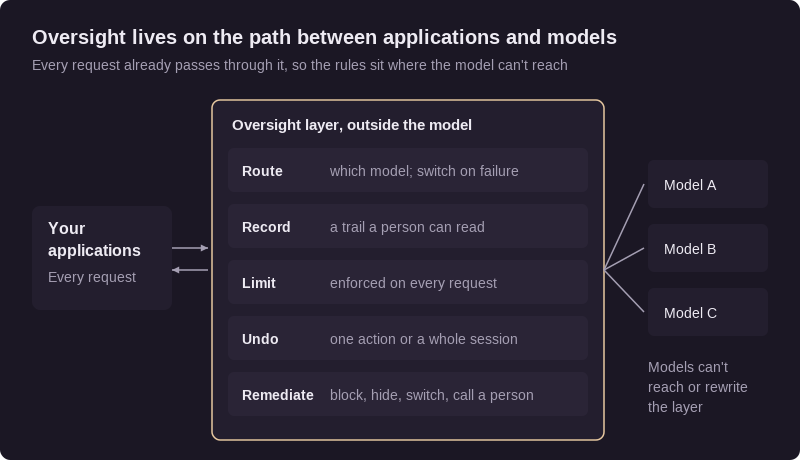
In practice that place is the path between your applications and the models. Every request already goes through it. That makes it the right place for oversight.
What that layer has to do
Route. No single model should be the only way to get an important result, and no model should mark its own work. The layer decides which model handles which request, and can switch when one fails or misbehaves.
Record. Every call leaves a trail a person can read: what the model was asked, what data it saw, what it did and what it answered. The record comes from the layer, not from the model’s own account of events.
Limit. The company decides what each model can access and which actions it can take, and those limits are enforced on every request, before anything happens.
Undo. Mistakes will happen, so changes made through a model have to be reversible, from a single action to a whole session. As The Register reported in July 2025, Replit’s AI coding service deleted a user’s production database despite instructions not to change any code without permission, then wrongly told him it could not be restored.
Remediate. When a policy is broken, the response shouldn’t wait for someone to read a dashboard. Block the request, hide the sensitive data, switch models or call in a person, automatically.
That is what Supervisor does. It sits between your applications and the models they use, routes every request, traces every call, rolls back what shouldn’t have happened and applies your remediation policies as it goes.
Better models won’t remove the need
Models will keep getting more capable, and that makes this layer more important, not less. A more capable model is given more access and more important work. The way to rely on it is the same way companies rely on any powerful insider: not by hoping it behaves, but by building a system that shows what it did, limits what it can do and makes its mistakes reversible.