Custom software is back.
For twenty years, companies bent their processes to fit off-the-shelf software. When building is cheap, that trade looks different.
Somewhere in the 2000s, custom software became a bad word. Building your own was slow and expensive, and keeping it running was worse. The sensible move was to buy: pick a product, adopt its way of working, pay the subscription. A generation of companies reorganized themselves around the tools they bought.
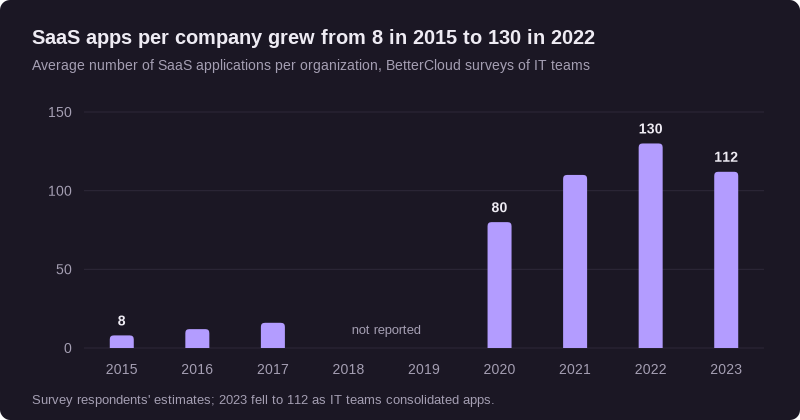
It mostly worked. It also left a mark. Most companies now run on a dozen or more products, each designed for an average customer. None fits exactly, so people fill the gaps by hand. They copy data from one system to another. They keep a spreadsheet beside the official tool because the tool can’t handle a case that matters. They follow the product’s workflow even where it doesn’t match how the business wants to work, because changing the product isn’t an option.
The cost of that mismatch is mostly invisible. It doesn’t appear on an invoice. It shows up as hours of re-typing, as errors between systems, and as a quiet ceiling on how the company can operate. If your best idea for serving customers better needs a workflow your software doesn’t support, you usually drop the idea.
The case for buying rested on the economics of building, and those economics have changed. Models now write most of the code in a new application. A system shaped around one company’s actual processes, which used to take a team a year, can be produced in a fraction of the time and kept up to date at a fraction of the cost. Investors have noticed: as CNBC reported in February 2026, software stocks sold off after Anthropic released AI tools for work that many software companies sell as products, leaving the S&P 500 Software & Services index down about 20% for the year.
That doesn’t mean every company should replace every product. Email, payroll and accounting are commodities for a reason, and good products exist for them. The change is at the edges, in the work that makes a company different: how it prices a job, plans production, prepares an offer or handles an exception. That’s where off-the-shelf tools fit worst, and where custom software makes sense again. Some companies are already making that call: in McKinsey’s 2026 survey on AI, as The Register reported in August 2026, nearly a third of respondents said their organizations had decided against buying software products or features and built them in house with AI coding tools instead.
There’s a catch, and it’s the same one that sank many custom projects in the past. Building the wrong thing quickly is no better than building it slowly. Custom software is only worth it if it matches how the business really works, and that knowledge is rarely written down. It sits with the people who do the work, in the workarounds they’ve invented and the spreadsheets that keep the official systems honest.
So the first step isn’t to write code. It’s to capture how the work actually happens, including the parts current software forces people to do by hand, and to agree on how it should happen. After that, the build is the easy part.
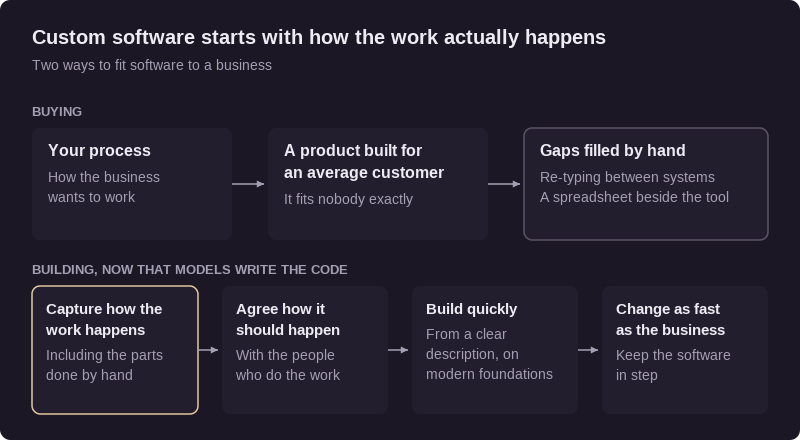
The pendulum is swinging back. Not to the slow, fragile custom systems of the 1990s, but to software built quickly from a clear description of the business, on modern foundations, that can change as fast as the business does.