Everyone is building agents. Nobody knows what to tell them.
Agents are becoming a commodity. What makes one useful is the knowledge you give it, and most companies haven't captured that knowledge yet.

Every software vendor now has an agent. Every consultancy has an agent practice. Every large company has a pilot where an agent drafts emails, answers tickets or files expenses. The technology is real and improving fast. It is also becoming the same everywhere: the same models underneath, the same frameworks around them, the same demos.
When everyone has the same engine, the engine stops being the advantage.
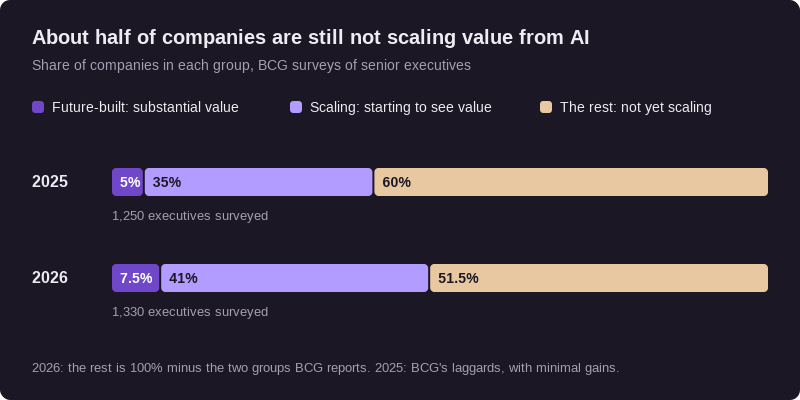
Many of those pilots never get further. As The Register reported in June 2026, Forrester found that three-quarters of enterprise leaders say they are adopting agentic AI, yet only a small minority have moved beyond pilots into meaningful production.
Watch what happens when an agent pilot stalls. It’s rarely because the model couldn’t do the task. It’s because nobody could tell it precisely what the task was. The agent processes the refund, but it doesn’t know that refunds above a certain amount for a certain kind of customer go to the regional manager first, because that rule exists only in the head of the person who used to do the job. It drafts the reply, but it doesn’t know which phrases legal asked the team to stop using last spring. It fills in the form, but it doesn’t know that one field is always left empty because a system downstream chokes on it.
An agent is only as good as its instructions, and the real instructions for most jobs have never been written down. Redis chief executive Rowan Trollope described the same problem to The Register in January 2026: an agent can apply a standard pricing policy easily, but replacing a person means learning when and why people make exceptions, and that knowledge usually sits in chat threads, email chains and text messages.
Companies try to close the gap with prompts. Someone senior spends a week writing a long document that explains how the job works. It’s incomplete on day one, because experts forget the things they do automatically. It’s stale by day thirty, because the work changes and nobody updates the prompt. And it doesn’t scale, because every team needs its own version and every version depends on one person’s memory.
The bottleneck has moved. The question is no longer “can the AI do this?” It’s “do we know, precisely and verifiably, what ‘this’ is?”
That’s a knowledge problem, and it has a different shape from a model problem. You solve it by capturing how work is actually done, from the evidence: the screens people use, the data they move, the decisions they make and the reasons they give. You formalize it into something a person can review and correct. And you keep it current, because the business keeps changing.
Once that knowledge exists, a lot becomes easy. You can automate a workflow with confidence, because you know what it is. You can rebuild an old application, because you know what it does. You can hand the same knowledge to whichever model is best next year, because it doesn’t live inside one vendor’s prompt.
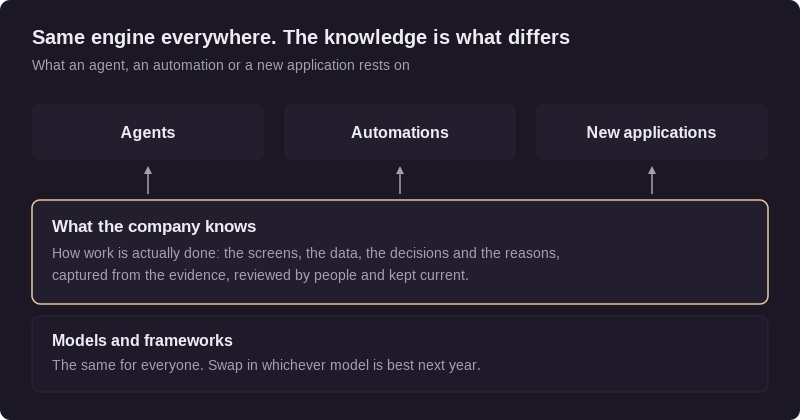
This is why we don’t describe what we do as building agents. Plenty of people build agents, and many build good ones. Our work comes first: finding out how work really happens inside a company and turning it into something software can run on. The agents, the automations and the new applications are what you build on top.