Your employees shouldn't have to learn prompting.
Asking every employee to become a prompt writer puts the burden of AI adoption on the people with the least time for it.

Most corporate AI rollouts follow the same script. Licenses are bought, a chat assistant is made available, and employees are invited to a training session on writing good prompts. A few enthusiasts get real value. Most people try it a few times, get mediocre results, and go back to working the way they did before.
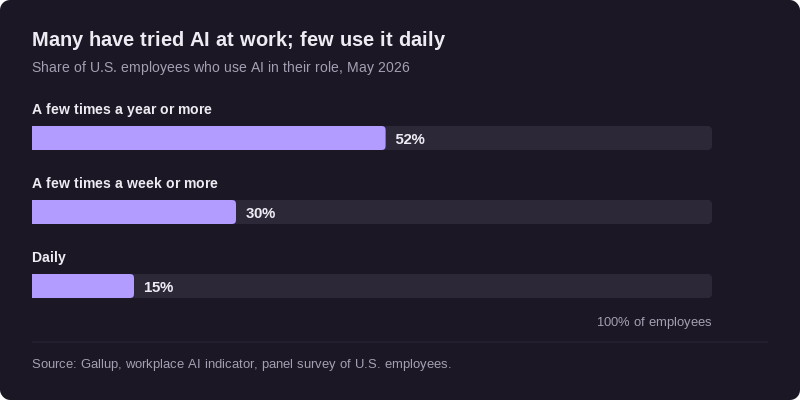
The usual diagnosis is that people need more training. We think the diagnosis is wrong.
Prompting well is a real skill. It means describing a task precisely: the context, the constraints, the exceptions, and what good output looks like. In other words, it means writing a specification. That’s exactly what experienced employees find hardest, not for lack of skill, but because their expertise is so practiced it has become invisible to them. Asking a senior planner to write down everything they consider when rescheduling an order is like asking someone to explain how they ride a bicycle.
It’s also a strange use of expensive people’s time. The employees who know the most are the busiest. A rollout that depends on them writing and maintaining long prompts competes with their actual job, and their actual job wins.
There’s a better division of labor. The knowledge needed to automate a task already shows up in the work: in the steps people take in their tools, the data they move, the decisions they make and the corrections they apply. With consent, that can be observed and turned into explicit workflows and rules, without anyone writing them from scratch. Where observation can’t explain a decision, a short question at the right moment, about a specific case, gets the reason in a sentence.
The employee’s role then changes from author to reviewer. Instead of writing a prompt that describes how they work, they look at a description drawn from how they work, and correct it: “yes, but not for key accounts”, “that step only happens at month-end”. Reviewing takes minutes. People are good at it. And the result is more accurate than what they would have written, because it starts from what they actually do.
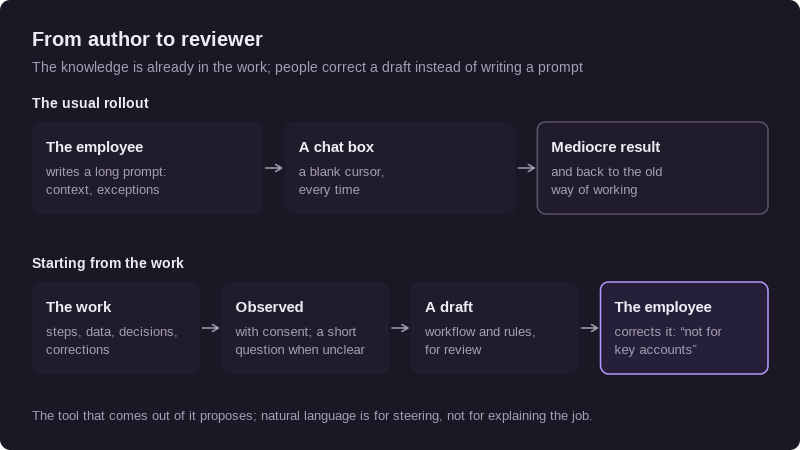
The same goes for the tools that come out of it. A well-designed AI system for a specific job shouldn’t need a prompt at all. A planner should see a proposed recovery plan when something breaks, not a blank chat box. An analyst should get a draft report with its sources, not a blinking cursor. Where natural language helps, it should be for steering (“don’t move that order”), not for explaining the whole job every time. An MIT study covered by The Register in August 2025 made a similar point: chat assistants are easy to try, but fail in critical workflows for lack of memory and customization.
Prompting will stay useful for open-ended tasks, and some people will get very good at it. The job title has already faded: in April 2025, The Wall Street Journal reported that prompt engineer, billed as the hottest AI job of 2023, was already obsolete, with a Microsoft executive saying the predicted boom was not turning out to be true. But a company’s AI strategy shouldn’t depend on every employee learning it. The knowledge is already there, in the work. The job is to capture it, not to ask people to type it in.