The case for forward deployed engineers, now that code is cheap.
Engineers who work inside the customer's company were long seen as an expensive exception. With AI writing the code, they become the most important part of the job.

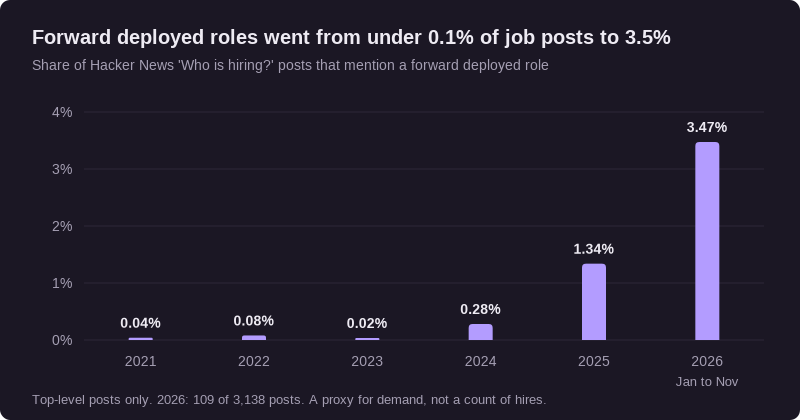
A forward deployed engineer works inside the customer’s company instead of at a distance from it. They sit with the people who do the work, use the real data, and build against the real problem, not the version of it that survived a sales call and a requirements document. Palantir made the role famous. As CNBC reported in October 2026, Lightcast counted more than 7,300 US job postings for forward deployed engineers in the first nine months of 2026, up from fewer than 200 in all of 2023. Today many AI companies hire for it, and the reason is worth spelling out.
Why the role is back
For most of the history of enterprise software, the expensive part was writing the code. It made sense to keep engineers together, far from customers, and send requirements to them.
That is no longer where the cost is. Models now write most of the code in a new application. What they can’t do is find out what the code should do. The rules that run a business live in people’s heads, in old applications and in email threads. They don’t come out in a workshop. They come out when someone watches the work, asks about a strange case, and hears: “Oh, for those we always do it differently.”
That someone has to be in the room. A model can’t earn the trust of a team that has watched failed projects before. It can’t notice that the person describing the process keeps glancing at a spreadsheet nobody mentioned. A forward deployed engineer can.
The old objection
The case against the model has always been economic. Forward deployed engineers are expensive, every deployment looks a little different, and a company full of them can start to look like a consultancy with a software logo. The critics have a point: the model doesn’t scale if every deployment starts from zero and everything the engineer learns leaves with them. Analysts see the same risk: as The Register reported in October 2026, Gartner warns that relying on a vendor’s engineers for every change creates lock-in, and advises customers to plan how they will take over once those engineers leave.
AI changes both of those things.
How we see the two together
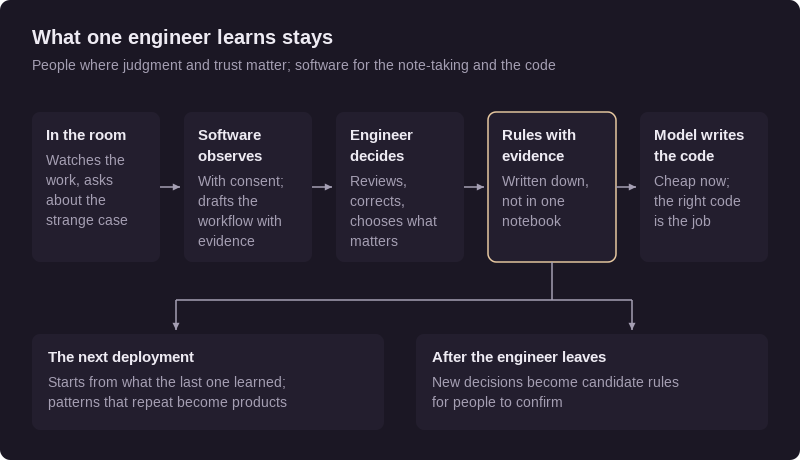
The engineer stops being the typist. When a screen that took a week takes an afternoon, the engineer’s time moves to the part that was always hardest: understanding the work, deciding what to build, and deciding what not to. The job becomes less about output and more about judgment.
The engineer gets help capturing what they see. Much of a deployment used to be note-taking: following people around, writing down steps, chasing answers. Software can now do a lot of that, with the consent of the people involved. It can follow the work in the tools they already use, ask a short question about a specific case, and draft a description of the workflow with the evidence attached. The engineer reviews it, corrects it and decides what matters. That is what we built CleanRoom for.
What one engineer learns stays. When knowledge is written down as rules with evidence, it stops living in one person’s notebook. The next deployment in the same industry starts from what the last one learned. Patterns that repeat become products. Ours started that way: something an engineer built inside one engagement, then needed again at the next.
The software keeps learning after the engineer leaves. A system built on formalized knowledge can turn each new decision people make into a candidate rule for them to confirm. The deployment doesn’t freeze on the day the engineer goes home.
What AI doesn’t change
Some things stay human, and they are the reason the role exists. Someone has to be accountable when a new system makes a mistake on a Friday afternoon. Someone has to tell the customer that the workflow they asked to automate should really be removed. Someone has to read the room. Models help with almost everything around those moments. They don’t replace them.
How we work
Every engagement we run starts with engineers working alongside the people who do the work. We use software to observe, ask and formalize, and we put people where judgment and trust matter.
The model writes the code. The forward deployed engineer makes sure it’s the right code.