Code is cheap now. Knowing what to build isn't.
Models write most of the code now. The expensive part of software has moved upstream, to understanding the work it is supposed to do.

For forty years, the cost of software was the cost of writing it. Estimates were counted in developer-months, and every feature request was weighed against how long it would take to build. That constraint shaped everything: which projects got approved, which systems were left alone, and why so many companies still run on applications nobody dares to touch.
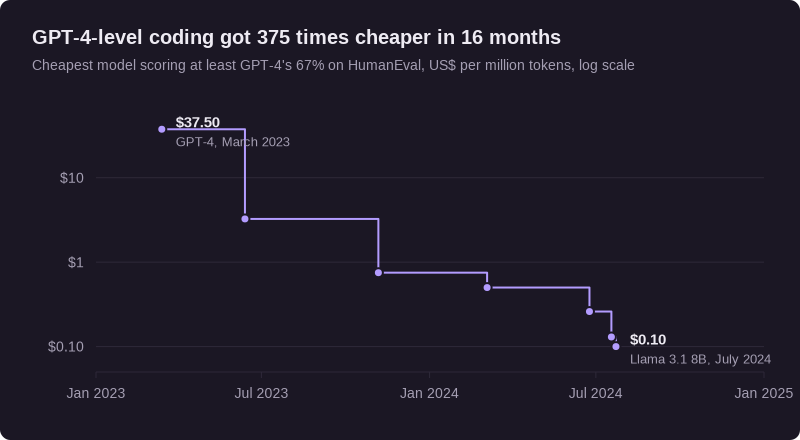
That constraint is gone. Today’s models write working code from a clear description, run the tests, read the error and fix it. A screen that took a team a week now takes an afternoon. Whole applications can be generated, checked and regenerated in the time a team used to spend on a project plan. As CNBC reported in April 2025, Microsoft’s chief executive, Satya Nadella, said that perhaps 20 to 30 percent of the code in the company’s repositories was already written by software.
So why aren’t companies replacing their old systems overnight?
Because the hard part was never the typing. Ask a team to describe what their billing tool does and you’ll get an hour of answers, plus a dozen exceptions nobody mentioned. The discount that needs a manager’s approval above a certain amount. The customer whose invoices go out on the 3rd, not the 1st. The field everyone leaves blank because the export breaks if you fill it in. None of this is written down. It lives in people’s heads, in old code nobody reads, and in email threads from years ago.
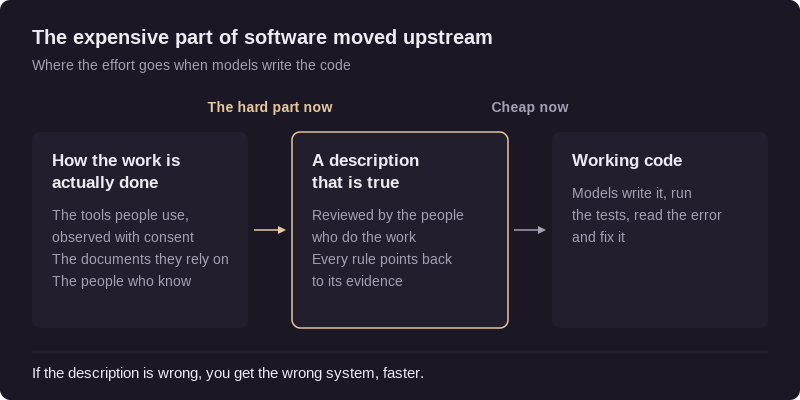
When code was expensive, this gap was hidden inside long projects. Developers discovered the exceptions one by one, months in, and patched them as they went. When code is cheap, the gap is all that’s left. A model will happily build exactly what you describe. If the description is wrong, you get the wrong system, faster.
This changes where the work is. The scarce skill is no longer turning a specification into code. It is producing a specification that is true: one that matches what the business actually does, including the parts nobody thought to mention. The toolmakers are moving the same way: when Amazon Web Services previewed its Kiro coding tool in July 2025, CNBC reported, the pitch was to define requirements, system design and tasks before writing any code.
That is harder than it sounds, for three reasons.
The people who know the work are busy doing it. They don’t have weeks to spend in workshops, and they often can’t explain what they do, because they stopped noticing it years ago.
Process documents describe how work was meant to happen, not how it happens. The real workflow has shortcuts, workarounds and a spreadsheet on someone’s desktop.
Some knowledge only shows up occasionally. The month-end close, the annual audit, the edge case that comes up twice a year. A short study misses them.
So we start upstream. Before any code, we capture how the work is actually done: by observing the tools people use, with their consent, reading the documents they rely on, and talking to the people who know. We turn that into a description everyone can review, where every rule points back to the evidence it came from. Only then do we build.
It’s a less glamorous story than “AI writes your software”. It’s also the one that ends with a system people actually use.